
Ancient civilizations were formed on the banks of rivers because of the resources they provided. The relationship these civilizations fostered with water is still relevant today as it teaches us to value this essential resource. The Indus Valley Civilization which was in its peak during 2500-1700 BCE, with major centres in modern day India and Pakistan, illustrates this relationship very beautifully.[1] There have been many studies on the behaviour of the civilization in response to changing conditions of the Indus River and the smaller rain fed Ghaggar-Hakra River.
Major centres of the civilization include Kalibangan, Mohenjo-daro, Harappa, Dholavira, Rakhigarhi and Ganweriwala. The population in Harappa and Mohenjo-daro was estimated to be around 23,500–35,000 and 35,000–41,250 respectively.[1]

Major Sites of the Indus Valley Civilisation
The civilization is renowned for its urban planning and has many first recorded instances of important inventions. These inventions include stepwells, public bath, hydraulic engineering, drainage, and advanced toilets. It had well developed water harvesting and supply facilities.
Water Supply and Wells
Several wells were built by the people at different sites of the Indus Valley Civilization. These wells served as a source of water for the people living both in settlements and cities. These included stepwells and circular brick-lined wells. There may have been over 700 wells built in Mohenjo-daro, in particular.[2]

Wells at Lothal and Dholavira

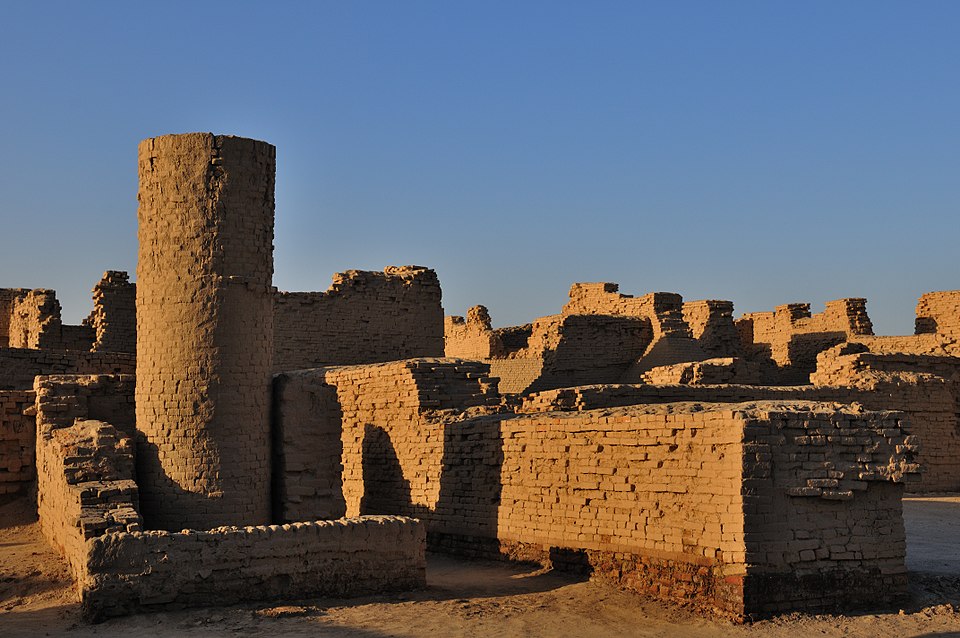
Tall Well (left) at Mohenjo-daro and a well at Harappa
Sanitation Facilities and Drainage System
The Indus Valley Civilization featured some of the most advanced sanitation systems of the ancient world..[3]
Many houses in city centres were equipped with bathrooms. These bathrooms were connected to drains for wastewater disposal. The drains were connected to larger public, often covered drains formed by precise brick laying. Water was also transported through terra-cotta pipes, which were found mostly intact in present times. The wastewater and sewerage were often collected in soak pits or jars underground which were probably periodically cleaned.[3], [4] Drains for controlling flow of monsoon water have also been reported.[5]

Drainage Systems in Harappa and Lothal

Bathroom Structure in Lothal
Cultural Water Related Sites
The Great Bath at Mohenjo-daro is one of the oldest, if not the oldest, public tanks in the world. It dates back to the 3rd millennium BCE. Its base is lined with bitumen and is made to be watertight. The exact purpose of the Great Bath is still in debate.[5],[6] However, some scholars suggest it was used for ceremonial or religious purposes.[2] This highlights the importance water and water bodies were given, even in ancient times.

The Great Bath at Mohenjo-daro
Water Harvesting Structures
There are many reservoirs throughout the Indus Valley Civilization thought to be constructed for the purpose of harvesting rainwater. Dholavira, in particular, had a large number of reservoirs lined with stone.[2] These were usually in the form of tanks with steps on the side to reach the water level. Evidences of similar reservoirs are found in Harappa and Mohenjo-daro.[7]
Scholars have raised the possibility that the Great Bath at Mohenjo-daro was also used to collect rainwater.[2]

Reservoirs at Dholavira
It is hypothesized that the drying up of water resources in some sites and flooding in others was a driving factor in the collapse of the civilization.[8] This serves as another reminder to appreciate the resource of water and use it judiciously, and to live in harmony with nature.
We can learn a lot from the past. Sophisticated water resources could be developed and sanitation facilities could be provided thousands of years ago. If this was done at a time when scientific progress was limited and technology was in its infancy, then surely, we can strive to do much better now. If ancient people had the foresight of water conservation and rainwater harvesting, we can be more determined towards these causes.
References
- Britannica Encyclopaedia: Indus Civilisation, https://www.britannica.com/topic/Indus-civilization
- History of Ancient and Early Medieval India: From the Stone Age to the 12th Century, Upinder Singh, Pg. 149-155 and Chapter 4, https://books.google.co.in/books?id=H3lUIIYxWkEC&source=gbs_navlinks_sA
- Sewerage in Ancient and Mediaeval Times, Harold Farnsworth Gray, Sewage Works Journal, Vol. 12, No. 5 (Sep., 1940), pp. 939-946 (8 pages), https://www.jstor.org/stable/25029094
- Civilisations of the Indus Valley and Beyond, Wheeler, Mortimer, https://www.indianculture.gov.in/ebooks/civilizations-indus-valley-and-beyond-0
- Indus Valley Civilisation- ISBN 978-92-3-102719-2, A. H. Dani and B.K. Thapar, https://en.unesco.org/silkroad/sites/default/files/knowledge-bank-article/vol_I%20silk%20road_the%20indus%20civilization%20BIS.pdf
- Britannica Encyclopaedia: Great Bath, https://www.britannica.com/place/Great-Bath-Mohenjo-daro
- Public Health Engineering Department, Government of Meghalaya: Rainwater Harvesting, https://megphed.gov.in/rainwater/Chap2.pdf
- Andrew Lawler, Indus Collapse: The End or the Beginning of an Asian Culture?, Science320,1281-1283(2008). DOI:10.1126/science.320.5881.1281
- Image Credit- Major Sites of Indus Valley Civilisation Image modified from:
- Indus Valley Civilisation Mature Phase Map- Via Wikimedia Commons, Author: Avantipura7
- Archaeological Ruins at Mohenjodaro- UNESCO
- Priest King Sculpture- Via Wikimedia Commons and World66.com, Author: Mamoon Mengal
- Harappan Terra-cotta toys- Author: Trish Mayo
- Granary and Great Hall at Harappa- Via Wikimedia Commons, Author: Muhammad Bin Naveed
- Rakhigarhi Archaeological Site- Via Wikimedia Commons, Author: Durgeshkushvaha
- Ancient Female Skeleton found at Rakhigarhi- Via Wikimedia Commons, Author: Nomu420
- Kalibangan Painted Pottery Pieces- ASI, Ministry of Culture, GOI
- Kalibangan Arterial Thoroughfare- ASI, Ministry of Culture, GOI
- Pot Furnace at Lothal- Via Wikimedia Commons, Author: Prof Ranga Sai
- Seals at Lothal- ASI, Ministry of Culture, GOI
- East Gate at Dholavira- Via Wikimedia Commons, Author: Rahul Zota
- Indus Scripts discovered at Dholavira- Via Wikimedia Commons, Author: Siyajkak
Well at Lothal- Via Wikimedia Commons, Author: Bernard Gagnon, Well at Dholavira- Via Wikimedia Commons, Author: Prof Ranga Sai, Well at Mohenjo-daro- Via Wikimedia Commons, Author: Usman.pg, Well at Harappa- Via Wikimedia Commons, Author: Obed Suhail, Drainage System in Harappa- Via Wikimedia Commons, Author: Haseeb Ur Rehman malik, Drainage System in Lothal- Via Wikimedia Commons, Author: Abhilashdvbk, Bathroom Structure in Lothal- Via Wikimedia Commons, Author: Bernard Gagnon, Great Bath- Via Wikiemdia Commons, Author: Saqib Qayyum, First Reservoir at Dholavira- Via Wikimedia Commons, Author: Bhajish Bharathan, Second Reservoir at Dholavira- Via Wikimedia Commons, Author: Lalit Gajjer
10. Creative Commons License Information: https://creativecommons.org/share-your-work/cclicenses/

Leave a Reply