
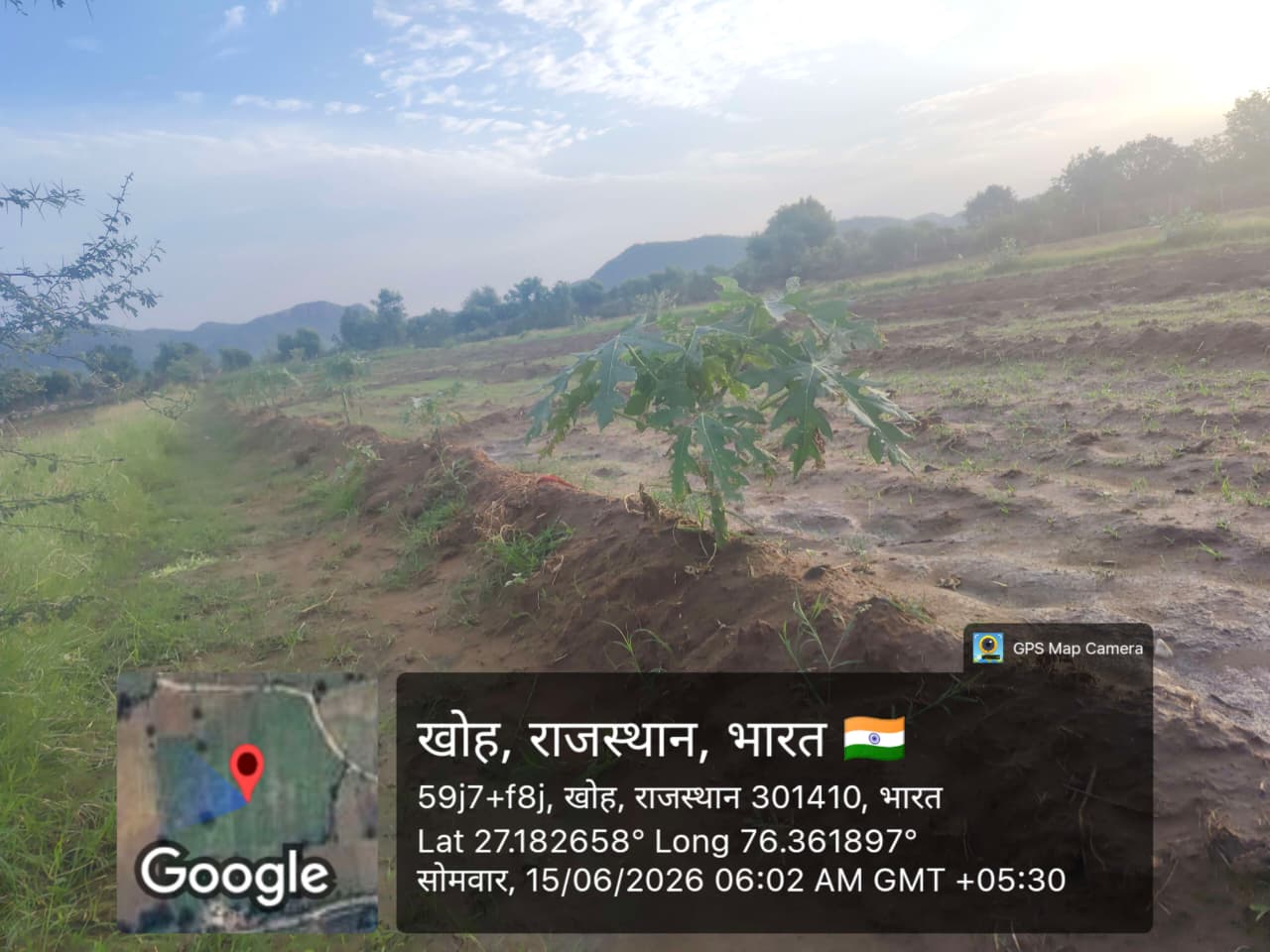
This year, we took a step towards enhancing farmers’ incomes by introducing papaya cultivation as a promising diversification option within local farming systems. In the villages of Alwar, Rajasthan, papaya cultivation is not traditionally practiced. The initiative aimed to explore its potential as a high-value crop that could contribute to improved farm incomes while promoting greater resilience and diversification in agriculture. With appropriate knowledge and management practices, papaya reaches productive maturity within a relatively short period, making it a promising option for increasing farmers’ incomes and reducing dependence on traditional crops.
Preparing farmers to adopt papaya cultivation has been a challenging process. Introducing any new crop requires farmers who are willing to embrace new ways of thinking and farming, take calculated risks, and engage in continuous learning. For smallholder farmers, the decision is particularly significant, as a portion of their limited land remains committed to the crop for an extended period, reducing flexibility for cultivating other crops. Additionally, for farmers who traditionally prioritize grain production for both household consumption and sale, bringing about such a change in farming practices is not easy. As a result, adopting a new crop requires both confidence in its potential and sustained technical support.
Even so, nine farmers from Kakrali Rampura and Khoh Dariba villages showed interest and commitment. At the beginning of March 2026, soon after harvesting their mustard or wheat crops and vacating their fields, they began preparing their land for papaya cultivation.
The variety selected was Red Lady 786. Saplings of this variety were supplied to farmers through a nearby nursery. Along with distributing the saplings, farmers were trained in planting methods and crop management, and the plantation was carried out. The saplings were only 6–7 inches tall. To the naked eye, they appeared very small. Many farmers expressed their apprehension that the saplings were too small and might not survive the summer. There was considerable doubt. The saplings were planted on raised beds. Some farmers planted 100 plants, some 150, while a few others established orchards with 300–400 plants.
My field visit on 19 March 2026 began at the papaya field of Mr. Deepak Dhobi, a cheerful farmer from Kakrali Rampura village. He had planted the papaya only 10–12 days earlier. He shared that every year after harvesting mustard, he goes to Delhi for three months to work as a construction labourer. This year, because he had planted papaya, he stayed back to take care of the crop. After meeting him, we also visited farmer Mahesh Jaiman and a few other farmers. March is one of those months when the weather changes rapidly. At that time, the main concern was that the weather should remain favourable and that extreme heat should stay away for a few more days.
Farmers invested much more than land in papaya cultivation—they invested their time, labour, and money in preparing their fields. They also committed themselves to taking proper care of this new crop. The papaya saplings were provided by the Delhi Premier Rotary Service Foundation and the Rotary Club of Delhi Premier under their PWABHI (Partners for Water Access and Better Harvests in India) programme . We (Aarangar Foundation) prepared the farmers, ensured technical assistance to them and encouraged them to adopt papaya cultivation in a focused manner.
I too felt the pressure of the time, money, and effort that had gone into this initiative.
What if the plants did not survive?
From the beginning of April until the second week, the weather remained favourable. There were occasional rains, and the papaya plants received some support from the weather. However, during the third week of April, temperatures rose suddenly.
Would the papaya plants be able to withstand this unexpected rise in temperature?
At the end of April, a survey was conducted to assess the condition of the plants. The first report came from Om Prakash Sharma of Khoh Dariba village. He had planted 355 saplings, but none of them survived. The rest had died rapidly. Another farmer from the same village, Daulat Ram Meena, had planted 250 saplings, of which only 82 survived.
This came as a shock. Monitoring had been taking place regularly. How had this happened? Why had it happened? What had gone wrong? What was that we couldn’t assess beforehand.
Detailed discussions were held with these farmers. In the initial conversations, both attributed the losses to the sudden heat wave that scorched the plants. Om Prakash Sharma’s son explained that he works as a tractor driver. The tractor is not his own, so he leaves in the morning and returns in the evening. As a result, he could not monitor the plants closely. He informed that the plants wilted rapidly and his family also could not help.
Electricity in their fields comes through the power line, which supplies power only from 9 a.m. to 2 p.m. During the days of intense heat, irrigation was therefore carried out during the daytime. This may have contributed to scorching of the plants and could be one reason for the losses.
Farmer Daulat Ram Meena still has 82 surviving plants out of the 250 he planted. If these plants also fail, there will be no successful example of papaya cultivation left in Khoh Dariba. Not only will the farmer lose income, but his investment will also be lost. Both his labour and financial investment will be affected. At the same time, the village will be left without a successful example of papaya cultivation, making it difficult to motivate other farmers.
Papaya is planted on raised beds rather than in pits so that water does not directly reach the main root. Excess water can quickly cause root rot. Daulat Ram Meena had also planted papaya on raised beds. However, when the team visited his field, they found that many of the beds had sunk. The farmer had created small depressions around several plants to hold water temporarily, as is commonly done around other crops. Flood irrigation is the primary irrigation method used by farmers in the area.
It appears that because the beds had sunk and depressions had been created around the plants, the papaya roots were exposed directly to the water. Excess water is harmful to papaya, and this may have contributed to plant loss.
During a long discussion, the farmer also shared that he had travelled to Jaipur several times in recent months, where he works for online delivery companies. This is an important source of income for him. Because regular monitoring was not possible and some irrigation management mistakes occurred, more than two-thirds of his plants were lost.
Over the past few weeks, the farmer has been repeatedly advised to rebuild the beds around the surviving plants. He has also been shown recent photographs of papaya fields belonging to other farmers as a source of encouragement and healthy competition.
Farmer Satya Narayan Jaiman, who has 50 surviving plants out of 95, and farmer Bhairu Lal Meena, who has 65 surviving plants out of 100, face a similar challenge. Electricity in their fields is also available only between 9 a.m. and 2 p.m. There is no single-phase electricity connection at the farm. As a result, water is available only during the day. The unavailability of water at the appropriate time has emerged as a major challenge for papaya cultivation.
Fortunately, 135 plants out of 150 plants of Farmer Deepak Dhobi have survived. This was encouraging to learn. I met him again just two days ago. He was cheerful as always. His plants had reached nearly two feet in height and looked healthy. He is currently constructing a permanent shed in his field. Once completed, it will help him monitor and manage his crops more effectively. He has access to single-phase electricity and irrigates only in the evening. He also regularly applies both manure and neem cake.
Farmer Mahesh Jaiman has nearly 300 surviving plants out of the 335 he planted. His field is perhaps the most impressive among all the farmers. He irrigates after 7 p.m. He showed us a bucket containing a mixture of neem cake and goat manure, which he applies to the plants every 6–7 days. He has also built a small shelter nearby and spends both days and nights there to monitor the crop. According to him, the use of neem cake has significantly improved plant growth.
We then visited the field of farmer Lokpal Sharma. He was not present, but from a distance the papaya plants appeared healthy and showed good growth. Out of 420 plants, around 370 have survived. We could not visit the field of farmer Harkesh Sharma, but during a phone conversation he informed us that around 270 of his plants out of total 305 plantsplanted by him on his farm had survived and were growing well. He too is a committed farmer.
How many factors influence the success of a new crop? Plant quality and weather are among the most important. If either of these is compromised, any crop can fail. Another critical factor is timely availability of water. Often, we consider only the availability of water itself. If water is available, we assume farming can continue. However, whether water is available at the right time for irrigation is equally important. The time at which electricity is supplied determines when irrigation can take place.
In addition, the farmer’s availability and commitment to farming are important factors. Small landholders cannot support their households through farming alone. Engaging in other work often helps them maintain their economic stability. However, if no one is available at home to look after the farm, even the best-intentioned initiative can fail. Farmers are likely to choose whichever activity provides quicker income, even if the returns are modest. Waiting for long-term returns is often difficult. For very small farmers with limited resources, immediate livelihood needs are so significant that investing time, labour, and resources in a new crop becomes much more challenging.
Another important point is that every new crop requires continuous technical guidance at every stage. Accurate and timely information on irrigation, pests, diseases, and nutrient management becomes extremely important.
This experiment is still in its early stages. The journey that began with nine farmers is learning from both successes and failures. In the coming months, it will become clear how many of these fields reach the production stage. What is already evident, however, is that these fields have started conversations about new possibilities in farming within the villages.
Perhaps that is the most important lesson from any new agricultural initiative: plants do not grow only in fields; they grow through a farmer’s time, trust, resources, and circumstances.



Leave a Reply